

Articles
Considering a Lobbyist Registry? What Councils Should Keep in Mind

Share Everywhere:
Reading Time: 4 minutes
When councils begin discussing a lobbyist registry, the conversation often starts with a shared goal: improving transparency and strengthening public trust.
At its best, a lobbyist registry gives residents clear, accessible insight into who is attempting to influence municipal decision-making, on what topics, and when. That visibility supports accountability without restricting access or discouraging legitimate advocacy.
As councils explore whether and how to introduce a registry, there are a few practical considerations that can help keep the initiative focused, achievable, and effective.
Why Councils Should Start With the Purpose of a Lobbyist Registry
A lobbyist registry is first and foremost a disclosure tool.
It exists to answer straightforward questions the public cares about:
- Who is lobbying elected officials or senior staff?
- What issues are being discussed?
- When are those interactions taking place?
Registries are not intended to regulate outcomes, limit access, or replace existing governance frameworks. They complement existing ethics rules and oversight mechanisms by making lobbying activity visible in a consistent, public way.
When councils keep that purpose front and centre, registry implementation becomes much simpler.
Responsibility Rests With the Lobbyist
One consideration that often comes up during registry discussions is the perceived time commitment required from elected officials or staff to log meetings, complete forms, or generate reports.
Modern lobbyist registries are designed specifically to avoid that.
With Lobby Registry, the responsibility for entering information rests with the lobbyist, not the councillor or staff member. Lobbyists submit their own disclosures directly into the platform as a condition of meeting with public office holders. Elected officials are not asked to create entries, manage records, or prepare reports.
This approach reflects how lobbyist registries already operate in many jurisdictions and is familiar to professional lobbyists, developers, and organizations that regularly engage with municipalities. For many, disclosure requirements are already part of standard practice.
Reporting Happens Automatically
Another common consideration is whether a registry creates additional reporting obligations for councils or staff.
In practice, the opposite is true.
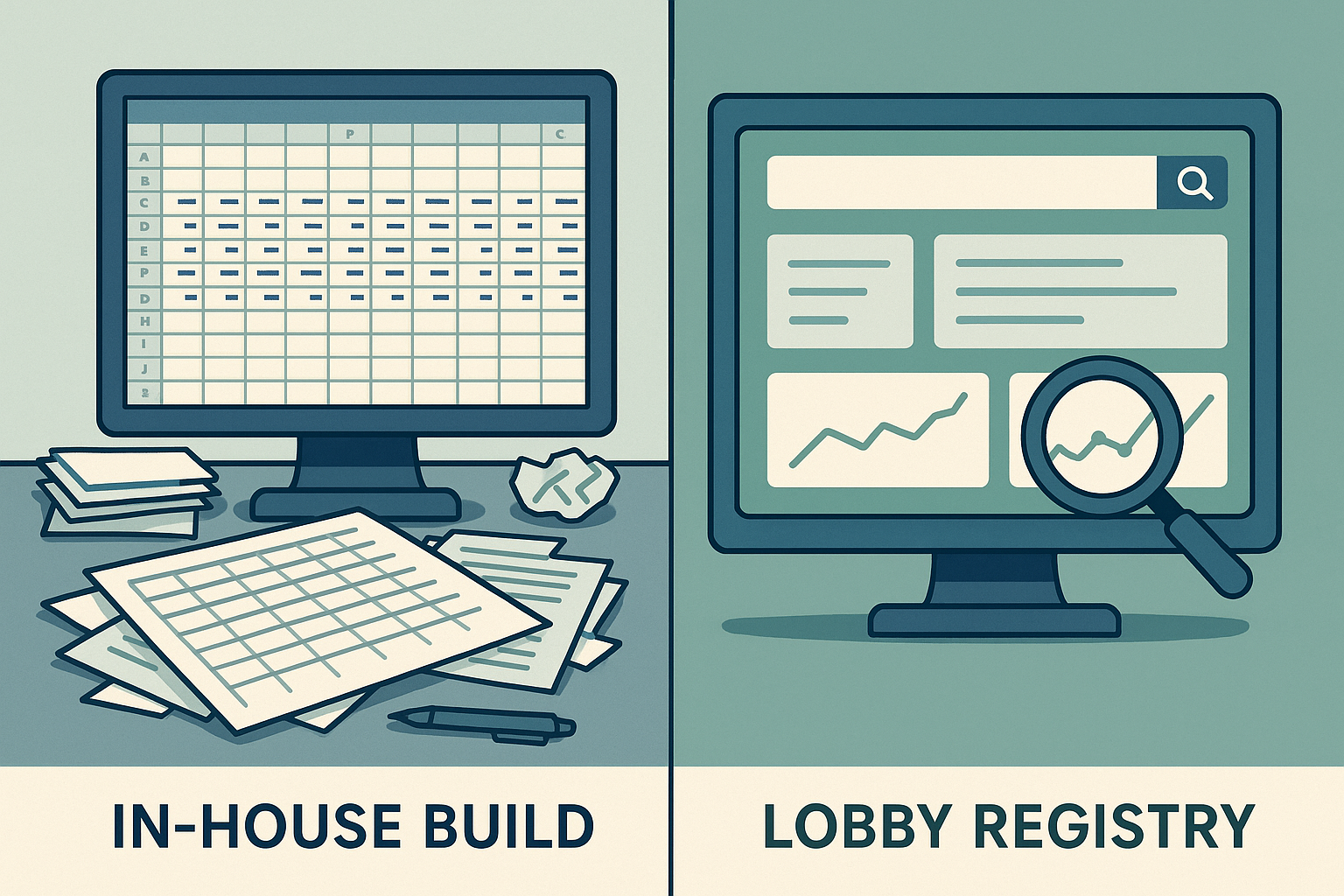
Lobby Registry automatically generates searchable, filterable, real-time public records. Councillors, staff, residents, and media can search by lobbyist, organization, subject matter, date range, or public office holder without submitting requests or asking questions.
Any reporting that is required can be generated directly from the platform. There is no separate reporting process and no additional administrative workload placed on the municipality.
Simple Rules, Simple Implementation
Implementing a registry does not need to be complex.
A clear and effective approach is straightforward:
- Before meeting with an elected official or senior staff member, a lobbyist submits a short entry in the registry.
- Once submitted, the entry is immediately available to the public.
- Oversight remains complaint-driven, supported by existing integrity processes.
This model is easy to communicate, easy to follow, and easy to enforce. It also reflects how many lobbyists already operate elsewhere, meaning there is little to no learning curve. The application is intuitive by design, and most users are able to complete an entry in minutes.
Auto-Approval Keeps Things Moving
To further streamline implementation, Lobby Registry includes an auto-approval option.
With auto-approval enabled:
- Lobbyist entries are published in real time
- No pre-review is required by staff
- Transparency is immediate
- Oversight remains available if issues arise
Auto-approval can be especially helpful during early implementation, allowing councils to launch quickly and build comfort with the system. Many municipalities continue using it long-term because it provides full transparency with minimal administrative involvement.
Approval settings can be adjusted at any time as needs evolve, without changing platforms or processes.
Transparency Should Be Self-Serve
Another consideration that is often raised is that residents can request information about who councillors are meeting with if they wish.
While this may be technically true, it places the responsibility on residents to ask, follow up, and navigate informal processes. That creates friction and inconsistency and limits access to those who already know what questions to ask.
A public lobbyist registry removes that barrier.
By making information available in real time and in one place, residents can independently view lobbying activity without submitting requests, sending emails, or relying on informal channels. Transparency becomes self-serve rather than request-driven.
Cost Should Not Keep Councils From a Lobbyist Registry
Cost is often cited as a key consideration when councils explore transparency tools. For that reason, affordability is a core design principle of Lobby Registry.
The platform is priced on a tiered basis, scaled to municipal population size, making it accessible to communities of all sizes. Even so, the cost remains modest and predictable, ensuring that transparency does not become a budgetary hurdle.
Lobby Registry was intentionally built to be affordable, because transparency should not be complex, expensive, or slow. Councils should not have to choose between fiscal responsibility and public trust. View Lobby Registry pricing details here.
How Lobby Registry Supports Councils
Lobby Registry was built to support councils that want transparency without unnecessary complexity.
The platform provides:
- A fully public, searchable lobbyist registry
- Lobbyist-led data entry
- Automatic reporting and advanced filtering
- Configurable auto-approval
- Minimal staff involvement
Councils can launch quickly, reduce administrative effort, and deliver immediate public visibility into lobbying activity. The system scales over time and adapts to evolving needs without requiring structural changes.
A Lobbyist Registry for Councils, Without Overcomplication
A lobbyist registry does not need to solve every governance challenge to be effective. Its value lies in making information visible, accessible, and consistent.
When councils focus on disclosure, rely on existing oversight mechanisms, and use technology designed for simplicity and affordability, registries become a practical and powerful transparency tool rather than an administrative exercise.
The result is transparency that is simple, affordable, and fast, and that works for councillors, staff, lobbyists, and most importantly, the public.
If your council is exploring a lobbyist registry, we would be pleased to provide a no-obligation demonstration of Lobby Registry and answer any questions about implementation. Click here to contact us to learn more.
All Articles





 FR
FR  EN
EN