

When municipalities begin exploring a lobbyist registry, the intent is clear: improve transparency, strengthen public trust, and provide visibility into who is influencing decision-making.
These are the right goals.
But where many initiatives struggle is not in why they are being proposed, it is in how they are designed.
This article is a practical guide for councillors and municipal staff to ensure a registry is implemented in a way that is effective, proportionate, and actually achievable.
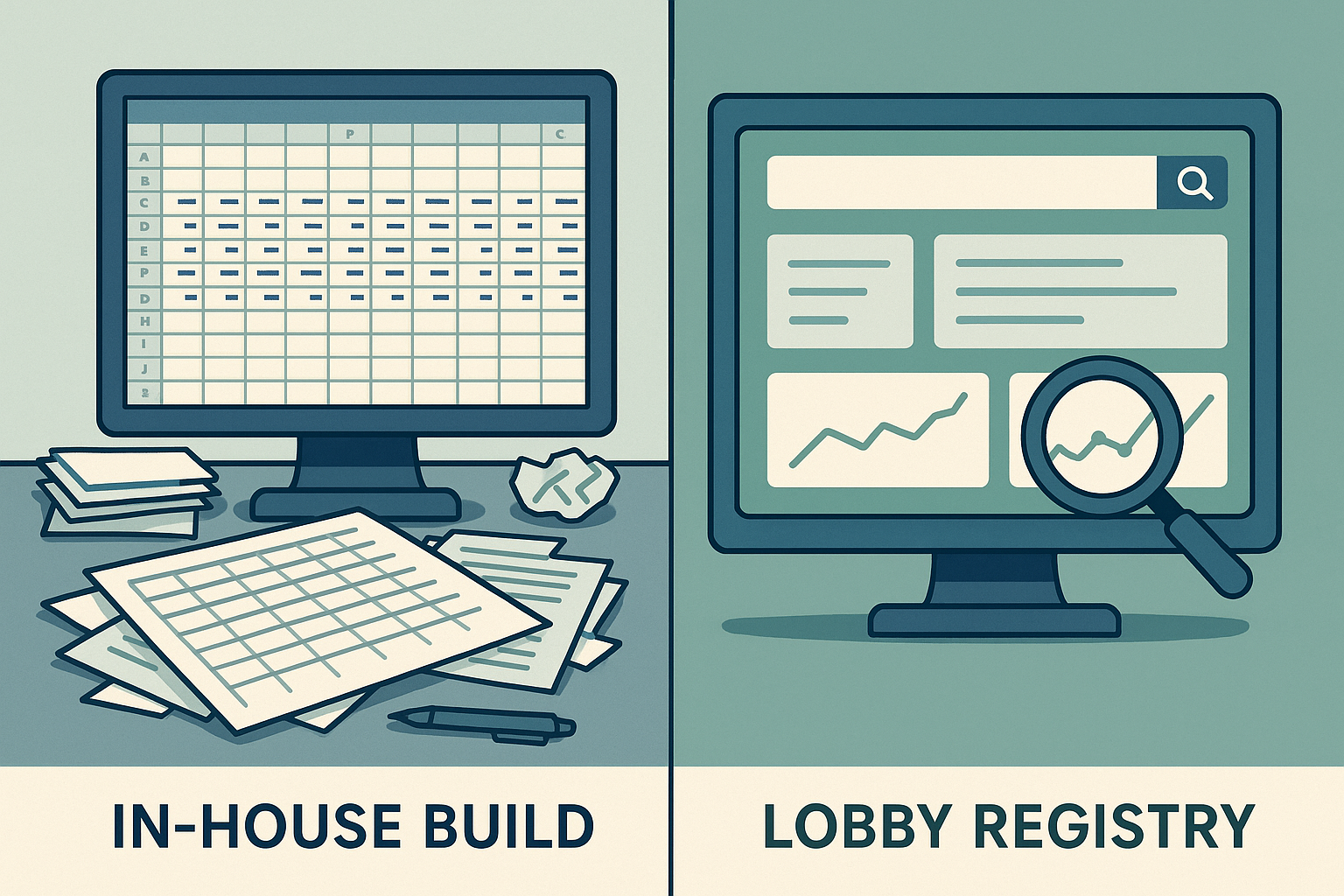
Today, implementing a lobbyist registry is not a technical challenge.
Lobby Registry already provides:
In other words, the tool itself is already solved.
Where municipalities run into trouble is not with the registry platform. It is with the governance layer around it.
Early in the process, discussions can quickly expand into:
At that point, the initiative becomes heavier than it needs to be.
It can also lead to inflated cost estimates and extended timelines, sometimes projecting implementations that take many months or even longer, with significant upfront investment.
That is not necessary.
With the right approach, a lobbyist registry can be:
The gap is not in what is possible. It is in how the initiative is scoped.
When the focus stays on transparency, supported by a modern platform like Lobby Registry, municipalities can move quickly, keep costs reasonable, and still achieve the intended outcome.
At its core, a lobbyist registry is a disclosure tool.
Its purpose is simple:
To create a clear, public record of who is communicating with municipal decision-makers and about what.
That alone delivers immediate value:
Importantly, in well-designed systems:
the responsibility for registration sits with the lobbyist, not with councillors or staff.
This keeps the system efficient, scalable, and easy to manage.
A registry does not need to regulate influence to be effective. It needs to make influence visible.
There is a place for more advanced governance:
But those elements should evolve over time, not be required on day one.
The key distinction is this:
Trying to solve every policy scenario upfront is what creates unnecessary complexity.
Instead, municipalities can:
This approach leads to better policy over time, rather than overbuilt policy at the start.
As a councillor, your role is to ensure that transparency is delivered in a way that is practical and sustainable.
When reviewing a proposed registry, consider asking:
If the proposal feels overly complex, it is reasonable to ask whether the same outcome can be achieved with a more focused approach.
Staff play a key role in shaping how a registry is brought forward.
One of the most effective ways to support council is to present scalable options, rather than a single fully built-out model.
For example:
This makes it clear that council is not choosing between “doing nothing” and “doing everything.”
They are choosing a path that can evolve over time.
A modern approach to implementing a lobbyist registry looks like this:
Lobby Registry is designed specifically for this approach.
It offers:
This allows municipalities to achieve transparency immediately, without getting delayed by unnecessary complexity.
The objective of a lobbyist registry is straightforward: make influence visible.
That objective can be achieved quickly with the right tool and a focused approach.
The risk is not underbuilding.
The real risk is overbuilding, especially at the policy level, before there is any real-world experience to guide it.
Start with transparency.
Let governance evolve with experience.
And ensure that a good idea does not become harder than it needs to be.






Lobby Registry is a consumer-facing web app owned and built by
J-SAS Inc.
 EN
EN  FR
FR